In today’s interconnected world, being a “Global Citizen” means more than just traveling across borders. It requires strong communication skills and an open-minded perspective. And at the heart of this global identity lies one essential skill: English. Whether for academic study, international careers, or cultural exchange, English proficiency is no longer optional—it’s essential. However, according tothe 2023 English Proficiency Index by Seasia Stats , Thailand ranks 101st out of 113 countries, trailing behind Myanmar (90th) and Cambodia (98th). Among 23 countries in Asia, Thailand is ranked 21st. This low proficiency level has become a national concern—prompting urgent reform and focus from Thailand’s Ministry of Education.
One of the key strategies? The adoption and integration of the Common European Framework of Reference for Languages (CEFR) into the national education system.
📘 What is CEFR?
CEFR and CEFR, short for Common European Framework of Reference for Languages, is an internationally recognized guideline developed by the Council of Europe. It provides a standardized system for describing and assessing language proficiency across different languages.
Origin:
- Developed in the 1970s
- Officially published in 2001, declared the “European Year of Languages”
- Aimed to:
- Promote intercultural understanding
- Establish a unified framework for language learning and teaching
- Facilitate mobility for study, work, and migration across borders
Global Acceptance:
Today, CEFR is widely used in Europe and beyond, including countries such as Japan, South Korea, China, and Southeast Asian nations like Thailand. It serves as a foundation for improving English teaching, assessment, and curriculum development.
🤓 What Are the CEFR Levels?
The CEFR (Common European Framework of Reference for Languages) is an international standard used to assess language proficiency. It divides learners into six levels, from beginner to native-like fluency.
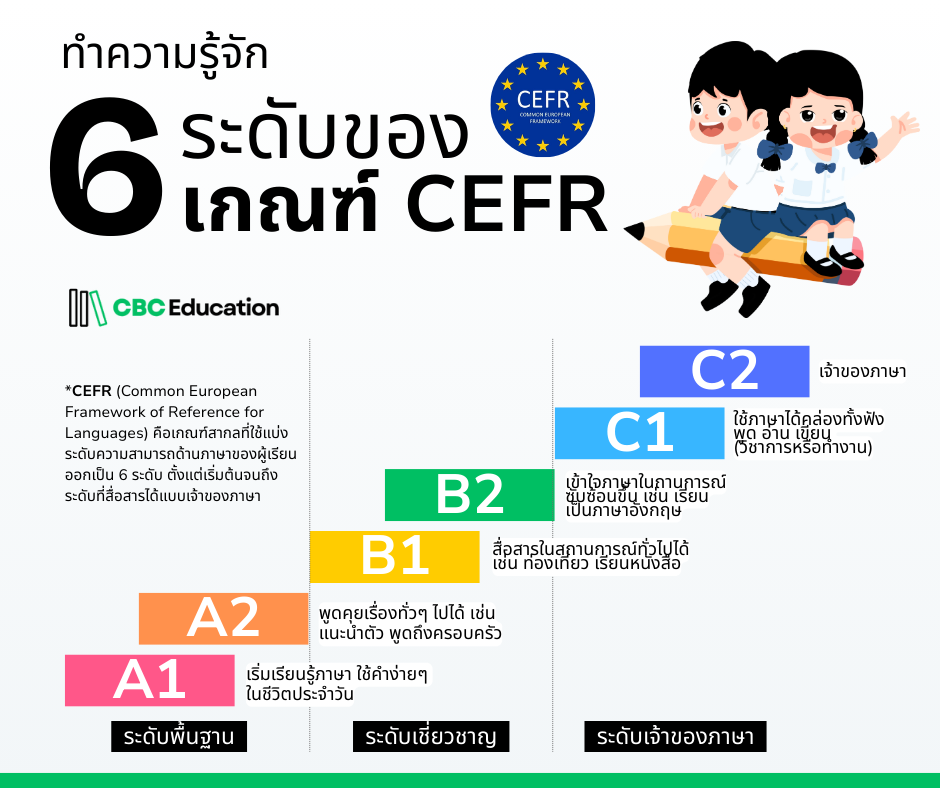
🔴A1 – Beginner
Who is it for? Absolute beginners
What can you do?
- Introduce yourself
- Ask and answer simple questions (name, age, location)
- Understand familiar words and basic expressions
Example:
- “My name is Tom.”
- “I like apples.”
- If a tourist asks you, “Where is the toilet?” and you reply, “Over there,”—you’re at A1!
🟠A2 – Elementary
Who is it for? Learners who can handle basic everyday situations
What can you do?
- Understand simple sentences about school, shopping, or family
- Write short sentences
- Hold basic conversations (but not fluently)
Example:
- “I go to school at 8 a.m.”
- “How can I get to the bus station?”
🟡B1 – Intermediate
Who is it for? Learners who can use English in a wider range of situations
What can you do?
- Understand everyday conversations
- Talk about familiar topics
- Read short articles
- Write emails or diary entries
Example:
- “Last weekend I went to the beach with my family.”
- “I think online learning is useful, but sometimes boring.”
🟢B2 - Upper Intermediate
Who is it for? Learners who use English well in many contexts
What can you do?
- Express opinions and explain reasons
- Watch English movies or news with little help from subtitles
- Write essays or formal emails
Example:
- “Social media is a great way to connect people, but it can also lead to misinformation.”
- “I’m planning to study abroad next year because I want to improve my English.”
🟦 C1 – Advanced
Who is it for? Learners who use English for academic or professional purposes
What can you do?
- Understand complex articles or discussions
- Write detailed reports or research papers
- Speak fluently on difficult topics
Example:
- “The concept of identity in modern society is constantly evolving.”
- You can discuss politics, economics, or science using field-specific vocabulary.
🔵 C2 – Proficient
Who is it for? Near-native or native-like users
What can you do?
- Speak, listen, read, and write fluently in all situations
- Understand humor, metaphors, and deep meanings
- Publish academic writing or give high-level presentations
Example:
- Writing literary reviews
- Discussing abstract topics like “Is free will an illusion?”
🎯Which CEFR level should students be at in each school year?
The Thai Ministry of Education (OBEC) has outlined general CEFR benchmarks for students at different grade levels to help them prepare for future studies and thrive in a globalized world. These targets vary depending on the type of classroom and the intensity of the English curriculum:

Standard Curriculum (OBEC)
For students in regular classrooms under the national curriculum, English language development is paced appropriately for each level, aiming for practical everyday communication skills:
- Grades 1–3 (Prathom 1–3): Students begin learning basic vocabulary and simple sentence structures like greetings and talking about familiar things. Target CEFR level: A1 (Beginner)
- Grades 4–6 (Prathom 4–6): Students develop the ability to handle slightly more complex language, such as describing daily routines or familiar topics. Target CEFR level: A1–A2
- Grades 7–9 (Mathayom 1–3): Students can engage in simple conversations related to daily life, such as asking for directions or giving basic information. Target CEFR level: A2
- Grades 10–12 (Mathayom 4–6) / Vocational Certificate (Por Wor Chor): Students are able to express themselves clearly in general topics, such as giving opinions or writing short essays. Target CEFR level: B1
Special Programs (EP, MEP, IEP, IIP / Gifted)
In special programs where English instruction is more intensive, students are expected to reach higher levels of proficiency, focusing on more complex language use and preparing for advanced academic paths:
- EP (English Program)A program where core subjects are taught in English. Students in these programs generally outperform those in regular classrooms. Grades 1–3: CEFR A1–A2 Grades 10–12: CEFR B2–C1 These students are being prepared for international academic environments.
- MEP (Mini English Program)English instruction is increased and some subjects are taught in English. Grades 4–6: CEFR A2 Grades 7–12: CEFR B1–B2
- IEP (Intensive English Program)Focuses on providing extra English instruction. Younger students: CEFR A1–A2 Older students: CEFR B1
- IIP / Gifted / English-Enriched Programs:These programs emphasize specialized skills such as academic writing or debate. They often aim to prepare students for competitive exams or studying abroad. Target CEFR level: Ranges from A1 to B1–B2, depending on the grade and program focus.
👉 👉 These benchmarks are not meant to pressure students, but rather to guide teachers in setting realistic goals and tracking progress more clearly and effectively at each stage. Having clear targets allows for better lesson planning and supports student development based on their actual ability.
🎓 What CEFR level should English teachers have?
It’s not just students who have CEFR benchmarks—English teachers also need to meet specific CEFR levels to ensure they can communicate effectively and teach English content appropriately for their students' level. According to policies from the Office of the Basic Education Commission (OBEC) , and the Ministry of Education, all English teachers are required to take the CEFR assessment. The minimum CEFR levels for teachers are as follows:
- Non-English subject teachers:Should have at least CEFR A2 (Basic understanding and ability to use simple English in general contexts.)
- General English teachers:Should demonstrate CEFR B2 proficiency (Able to communicate fluently with students and teach English content confidently.)
- Teachers in EP / IEP programs:Should reach CEFR C1 or higher (Capable of using academic-level English and teaching multiple subjects in English effectively.)
👉 These CEFR benchmarks are used both in recruiting new teachers and in professional development programs to ensure teachers have the necessary language skills to teach effectively and support student learning.

🏛️ Who sets the CEFR standards?
The CEFR framework used in Thailand is guided and promoted by multiple key organizations, including:
- Ministry of Education (MoE)
- the Office of the Basic Education Commission (OBEC)
- National Institute of Educational Testing Service (NIETS)
- Office of the Teacher Civil Service and Educational Personnel Commission (OTEPC)
Additionally, there is strong collaboration with international organizations such as the British Council and Cambridge Assessment English in developing curricula, teacher training programs, and assessment frameworks that align clearly with CEFR standards.
Adopting CEFR as a benchmark for English language development in Thai education allows students to set clear learning goals and track their progress effectively. That said, support from teachers, parents, and schools—through activities and programs that encourage English learning—is essential for helping Thai students reach internationally recognized standards.
🧪 What does a CEFR-based test assess?
CEFR assessments focus on four key language skills:
| Skill | Indicators |
|---|---|
| Listening | Understanding messages, conversations, news, and spoken instructions |
| Speaking | Engaging in conversations, answering questions, presenting, and interacting fluently |
| Reading | Understanding texts, ads, menus, news, and various written materials |
| Writing | Composing emails, notes, reports, essays, or letters |
These tests can be delivered in various formats:
- Paper-based or online
- General or academic versions
- Suitable for schools, universities, and professional institutions
✨ Popular CEFR-aligned English proficiency tests
| Test Name | CEFR Levels | Common Uses |
|---|---|---|
| Cambridge English (A2 Key, B1 Preliminary, B2 First, C1 Advanced) | A1 – C2 | Education / Job applications |
| IELTS (Academic/General) | A2 – C2 (Score 0–9 can be mapped to CEFR) | Study / Work |
| TOEFL iBT | B1 – C1 | Study abroad |
| Oxford Test of English | A2 – B2 | General use |
💬 In Summary
By setting CEFR targets for different types of English programs, both teachers and students benefit from a clear direction. This approach ensures effective teaching and learning at every level, whether in regular or special programs. When students are taught at the right CEFR level, they can develop their English skills efficiently and confidently to meet their goals.
📌 📌 Interested in organizing international study trips or exploring AI-powered English learning packages for schools?
Feel free to contact us — we’re happy to offer tailored advice and create programs that fit your students’ needs perfectly. 💼✈️📱